

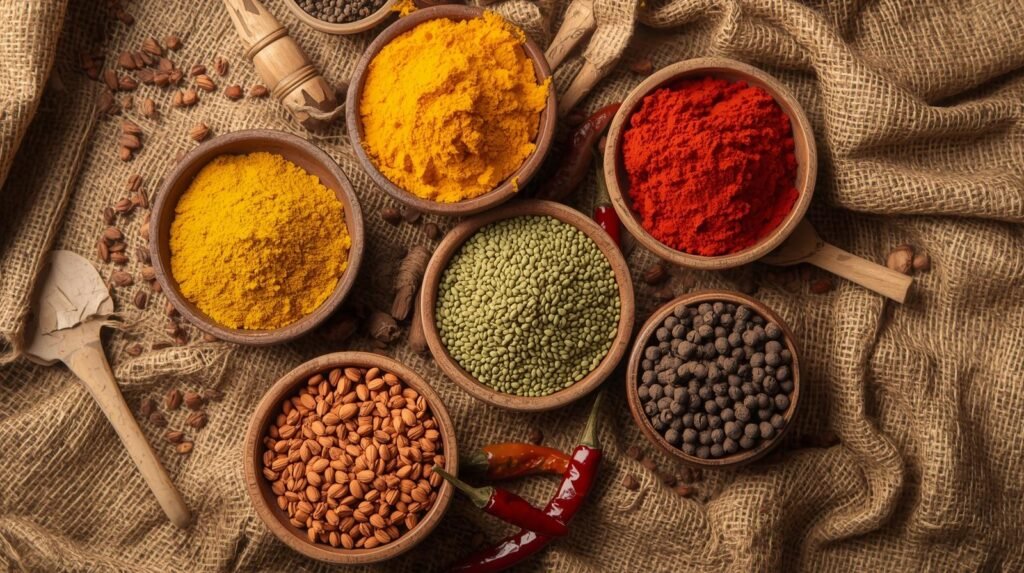
Short takeaway: India remains the world’s largest spice exporter in 2025, but the market is patchy — some spices (turmeric, black pepper, organic blends) show robust demand and price support, while others (certain red chilli varieties) face volatility caused by crop cycles, quality issues and shifting buyer preferences. This report summarizes export volumes/value, price trends, buyer demand, trade terms, and actionable recommendations for exporters and B2B buyers. India Brand Equity Foundation+1
1. Snapshot — India’s spice exports in 2024–25
- Export value: India exported spices worth roughly US$4.4–4.5 billion in FY24 (and continued strong exports into FY25). This confirms India’s leadership in global spice trade. India Brand Equity Foundation+1
- Top export items: Turmeric, red chilli (powder & whole), cumin (jeera), coriander, black pepper, cardamom and many value-added forms (powders, oleoresins). Item-wise breakdowns and country-level tables are published by the Spices Board of India. Indian Spices
Why this matters: value and item mix tell exporters which SKUs attract buyers and where to push capacity (whole vs powder, standard vs organic, commodity vs value-added).
2. Global demand trends 2025 — what buyers want
- Health & clean-label demand (organic, non-GMO, traceable): Organic and certified spices continue to grow faster than the commodity market. Market reports estimate the global organic spices market expanding from ≈US$31.7B (2024) to ~US$34.5B in 2025, showing strong consumer-driven demand that benefits certified exporters. Research and Markets+1
- Value-added formats: Finished formats — blended masalas, oleoresins, spice pastes, ready-to-use powders — are preferred by food manufacturers and private-label brands because they reduce processing costs at the buyer end. Stellar Market Research
- Sustainability, traceability, and certification are table stakes: Importers in EU/US/Gulf are explicitly asking for APEDA/APEC/NPOP/USDA/EU organic, HACCP/ISO, lab results and chain-of-custody documents. Buyers will pay premiums for reliable documentation. APEDA+1
- Geographic demand pockets: Europe and North America remain large premium buyers (organic & processed), while Middle East and Africa buy volume (whole spices, chilli). Emerging demand is visible in South-East Asia and parts of Latin America. India Brand Equity Foundation+1
3. Price trends — who’s up and who’s down (2024 → 2025)
Turmeric: Prices saw upward pressure during 2024–25 driven by export demand and quality differentials (curcumin levels). Regional mandi outlooks in 2025 reported turmeric trading ranges that supported exporter margins. (See regional turmeric outlooks for round-the-year price guidance.) PJ Telangana Agricultural University+1
Red chilli: Highly volatile — some export varieties saw weaker early-2025 demand and falling prices due to surplus stocks and quality rejection in some consignments. However premium export varieties (Byadgi, high-SHU types) maintained firmness. Expect continued volatility linked to crop cycles and sample test results. Retexport+1
Black pepper & whole spices: Black pepper and whole spices are more stable and driven by manufacturing demand (seasonings, sauces). Global manufacturing growth supports moderate price recovery. Stellar Market Research
What affects prices right now: cultivation area shifts, weather, moisture and drying quality, phytosanitary/chemical residue test results, and international freight & container availability (which raises landed costs). The Times of India+1
4. Volume & country-level demand (export corridors)
- Key buyers: USA, UK, Germany, Netherlands, UAE, Saudi Arabia, Australia, and South-East Asian hubs. APEDA / Spices Board’s item-wise country tables show where specific spices move in volume and value — useful when picking target markets for each SKU. Indian Spices+1
- Emerging corridors: Middle East continues to import commodity spices in bulk; EU/US demand is shifting to organic and value-added SKUs. Consider tailoring offerings per corridor (bulk whole spices for ME/Africa; certified organic powders & blends for EU/US). Research and Markets+1
5. Certification, testing & quality — non-negotiables for 2025
Buyers increasingly reject consignments for residue or micro counts. To stay competitive, exporters must provide:
- APEDA registration, FSSAI, NPOP / USDA / EU Organic (if organic), HACCP / ISO 22000, and third-party lab certificates. APEDA+1
Operational checklist for exporters:
- Pre-shipment pesticide-residue testing (GLP lab)
- Microbial testing and steam-sterilization certificates when required
- Batch-level traceability (farm → lot → pack)
- Clear, export-ready documentation bundles (origin, phytosanitary, COA)
This reduces rejections and speeds buyer approvals.
6. Logistics & pricing terms — what buyers are asking
- Trade terms: FOB and CIF remain common; sophisticated buyers ask for DDP for first-time small private-label orders. Provide transparent FOB/CIF calculators showing price per kg at different container sizes (20ft/40ft).
- Packaging: Bulk sizes (25kg / 50kg jute or laminated sacks) are standard, with private-label laminated inner bags for traceability and shelf-life.
- MOQ & lead times: Typical B2B MOQs for powders/whole spices are 500 kg – 1 tonne, and full container orders (16–20 tonnes) for 20ft/40ft containers. Lead time from order confirmation to shipment varies (15–30 days depending on processing and testing). Indian Spices
7. Opportunities for Indian exporters in 2025
- Scale organic & certified lines: Organic spices command higher margins and growing demand; invest in certified farm clusters. Research and Markets
- Develop value-added SKUs: Oleoresins, spice blends, private label packs for retailers and food manufacturers. Stellar Market Research
- Improve quality control & traceability: Fewer rejections → stronger buyer relationships → repeat orders. APEDA
- Market segmentation by corridor: Offer bulk commodity lines for Middle East/Africa and certified processed lines for EU/US. India Brand Equity Foundation
- Digital storefront + product catalogs: B2B buyers increasingly start with supplier websites and catalogs. Provide downloadable COAs, MOQ details and lead-time calculators.
8. Risks & how to mitigate them
- Price volatility (esp. chillies): Use forward contracts and diversify varietal mix. Monitor mandi data and NCDEX futures for hedging ideas. PJ Telangana Agricultural University+1
- Quality rejection: Invest in pre-shipment third-party testing and steam sterilization if needed. APEDA
- Freight & delays: Lock space with reliable freight forwarders; offer flexible trade terms or absorb partial logistics cost for strategic buyers.
9. Quick action plan for exporters (next 90 days)
- Audit certifications — ensure APEDA, FSSAI and buyer-relevant organic/HACCP certificates are current. APEDA+1
- Create route-to-market playbook for EU/US (organic & processed) and Middle East/Africa (bulk whole/commodity). India Brand Equity Foundation
- Publish product sheets with COAs, MOQ, packaging, lead times, and FOB/CIF estimates on website.
- Engage with trade shows & APEDA programs — presence at key trade fairs and APEDA pavilion helps opening doors. APEDA
10. FAQ (SEO-friendly quick answers)
Q: Is demand for organic spices growing in 2025?
A: Yes — the organic spices market is expanding strongly, with market research projecting year-on-year growth and rising buyer interest in certified organic SKUs. Research and Markets+1
Q: Which spices give best export margins today?
A: Value-added and certified organic powders (turmeric with high curcumin, organic black pepper, oleoresins) generally yield better margins than low-grade commodity chillies — though pocket-specific opportunities exist. PJ Telangana Agricultural University+1
Q: What documentation do buyers expect?
A: APEDA registration, FSSAI, phytosanitary certificate, COA (pesticide residues & micro), organic certification (if applicable), and packing list/invoice. APEDA+1
Sources (key references)
- Spices Board of India — item & country export tables. Indian Spices
- APEDA (reports & promotion programs; organic export studies). APEDA+1
- IBEF — India spices export overview and export values. India Brand Equity Foundation
- Organic Spice Global Market Report / ResearchAndMarkets & Future Market Insights — organic market sizing / growth. Research and Markets+1
- Regional commodity outlooks (turmeric / chilli price briefs) — PJTSAU, Igrain, SpicesIndia market articles. PJ Telangana Agricultural University+2iGrain+2
Closing — what exporters & buyers should do next
For exporters: prioritize certified organic lines, strict quality control, and route-to-market segmentation (EU/US for certified & value-added; ME/Africa for bulk). For buyers/importers: request batch-level COAs, clear MOQs and FOB/CIF quotes, and consider contractual quality checks to reduce rejection risk. The next 12–18 months will reward suppliers who combine traceability, certification and reliable logistics.
Would you like this converted into a downloadable PDF report (with charts) or a shorter one-page executive summary you can email to buyers?